Spotted Owl Fallout?

Last week, after attending the NFMA roundtable in DC, my 12-year-old daughter McKenzie and I had dinner with Dan Sarewitz, his wife Erica Rosenberg and their 10-year-old son Jonah. Erica and I have known each other since her tenure on the House Natural Resources Committee staff where she helped shepherd the first iteration of Secure Rural Schools through Congress. Jonah and I have played ping pong a couple of times — he’ll be really good some day!

Although I have read several of Dan’s writings on science policy, this was our first meeting (actually, we met the day before dinner on Connecticut Avenue as McKenzie and I walked to the metro after visiting the national zoo — small world, indeed).

Dan asked me a question that has defied easy analysis for twenty years. Did winning the spotted owl lawsuits do more harm than good? I invite your thoughts. I’ll save mine for the next post.

Words, words, words

In 1990, with one round of NFMA plans under its belt (but not yet knowing the wheels were about to come off), the Forest Service critiqued its planning process. The first recommendation to issue from that critique was to “Simplify, Clarify, and Shorten the Planning Process.”

Does the proposed new rule do so? The 1982 (aka, the current process) rule has 15,548 words. The proposed rule has 15,227 words. For perspective, the “unworkable” 2000 rule had 13,300 words. With those statistics, I doubt the new rule simplifies, clarifies or shortens.

[Updated — The 2012 rule has 13,252 words.]

BTW, my proposed K.I.S.S. rule has 1,400 words.

Now’s the time to comment . . . not

SECOND UPDATE — The FS planning blog is working now.

UPDATE — The FS’s planning rule blog appears to be back on-line. Peter Williams ([email protected]) is moderating it. Still no comments from anyone on the new rule.

Thursday, 2/10, saw the Forest Service unroll its proposed new forest planning rule. The rule’s unveiling was featured on the FS’s homepage. Media from coast-to-coast covered the event. And the public was invited to comment on the new rule, including on the planning rule blog.

Previous blog posts had received anywhere from several to several dozen comments, so I expected the rule’s release to stimulate some vigorous debate.

By Tuesday, 2/15, not a single comment had been posted on the FS’s blog. What’s up with that, I wondered? So I posted a comment (well, re-posted something cynical I had already placed here).

Now I know the FS moderates its blog, just as NCFP does. But by day’s end, nothing had appeared. So I emailed the blog moderator. Got the following response:

I will be out of the office starting 02/13/2011 and will not return until
08/15/2011.

I’m on detail to CEQ through mid August. If you have questions about the
planning rule please contact Megan Wertz ([email protected]), Linda
Parker ([email protected]) or Martha Twarkins ([email protected]).

We really do want your comments . . . we’re just not home to receive them.

Tester Uses His Seat On Appropriations Committee

Senator Majority Leader Reid released today a draft of the 2011 Consolidated Appropriations Act, which he hopes to navigate through the last days of this Congress. The 1,924-page bill includes Senator Tester’s Montana Forest Jobs and Restoration Act (beginning on page 893), but does not include Senator Wyden’s Eastside Oregon counterpart. Tester sits on the Senate Appropriations Committee, from which this bill originates; Wyden does not.

This omnibus appropriations bill should not be confused with an omnibus public lands bill that has also been released in draft. The public lands omnibus includes bills passed out of the Senate Energy and Natural Resources Committee, including three designating wilderness in Oregon (Devil’s Staircase), Washington (Alpine Lakes additions) and New Mexico (Organ Mountains-Desert Peaks).

Does Anyone Read the Errata Sheets?

A 46-page 2nd “errata” sheet accompanies the Forest Service’s FY 2011 budget. All but one of the corrections are of no particular consequence.

The eye-popper is almost at the end (where else?). The Forest Service proposes to increase stewardship contracting targets by six to eight-fold compared to previous years. Timber volume from stewardship contracts will increase from 413 mmbf (2010 target) to 2 billion b.f. Biomass energy fuel will increase from 376,000 to 2.6 million tons. “Acres of wildlife habitat improved” (I’ve never understood what that means) go from 8,630 to 100,000 and noxious weed-treated acres (I’ve got a better handle on that notion) sky-rocket from 1,292 to 180,000.

Somehow these Herculean feats will be pulled off by reducing stewardship contracting spending from $6.5 to $6.0 million. And with zero employees, too (huh?).

So I thought, “Maybe the errata sheet itself is one big typo?” I called the Washington Office. The helpful lady said that these numbers reflect the Chief’s commitment to the stewardship contracting program. When I pressed her on how the FY 2011 numbers compared to previous years, she said “someone from upstairs will have to get back to you tomorrow.” No one did.

The Rise (and Fall) of Tidwell’s Four Pillars

Alternate Title: “What happens if a pillar falls in the woods and no one hears it . . . ”

Former Chief Dale Bosworth had his Four Threats: fire and fuels, invasive species, loss of open space, and unmanaged recreation. Current (but for how long?) Chief Tidwell’s signature initiative was to be his “Four Pillars”: Restore and Sustain Landscapes, Protect and Enhance Water Resources, Jobs and Sustainable Communities, and Climate Change Resiliency.

But Tidwell’s pillars have fallen before construction even began because he wasn’t paying attention to one minor detail. His boss, Secretary of Agriculture Vilsack, already had “Four Pillars” — renewable energy, broadband internet access, responding to climate change and harnessing local food production.

Your Forest Service leadership hard at work.

Forest Service Leadership Sinks Morale

Forest Service Chief Tidwell responded this week to the agency’s “morale focus groups,” which convened in response to the Forest Service’s basement-dwelling rankings as a good federal agency workplace. In the survey, employees ranked Forest Service leadership 217th out of 223 federal agencies. Tidwell’s response? He appointed a new director for the Office of Communications “tasked to work on the effectiveness of our internal communication,” among other actions that also include a “major commitment to improving safety.” Tidwell thinks the troops have low morale because they just aren’t getting his messages and working unsafely to boot.

The good news this week is that Associate Chief Hank Kashdan is retiring. Kashdan played a key role in centralizing the Forest Service personnel functions in a new Albuquerque Service (sic) Center. This supposed cost-savings measure, for which there is no evidence of saved dollars, fouled-up hiring, payroll, travel, and other day-to-day chores that should be seamless in any well-run organization. Kashdan’s departure is a welcome start, but the exodus shouldn’t stop with him. That low-leadership ranking was also well-earned by Chief Financial Officer Donna Carmical who retaliated against Forest Service auditor Jeffrey Park after he blew the whistle on former CFO Jesse King’s travel embezzlement scheme. Former Chief Gail Kimbell earned the first-ever directed reassignment for a Chief when she recommended King for a performance raise even while he was being investigated for his malfeasance.

The housecleaning should also sweep up Chief of Staff Tim DeCoster who “reviewed and approved” Jesse King’s fraudulent travel vouchers. In addition to looking the other way as King fleeced the government, DeCoster’s position as Chief of Staff makes him the top day-to-day agency manager; a position he has held throughout the Forest Service’s steep descent to the bottom of the government’s morale rankings.

This better-off-without list wouldn’t be complete without the head guy himself, Tom Tidwell. Tidwell’s biggest failing is that he hasn’t done the housecleaning at the top that is needed to restore leadership as meaning something other than perks for the top dogs. Tidwell’s resignation would be the biggest boost to agency morale he has to offer.

Should Wilderness Be Made Safe?

Next week the Forest Service plans to explode some trees. With dynamite. In a wilderness. To protect hikers.

The 150 large, dead or dying hemlocks lie along the Joyce Kilmer trail that snakes through the 17,394-acre Joyce Kilmer-Slickrock Wilderness in North Carolina. The trees are victims of the hemlock woolly adelgid, a non-native insect. The Forest Service proposes to blast the tops out of the trees, lessening their chance of falling on someone, while preserving the appearance that the trees were snapped by wind and not cut by saw.

The Wilderness Act requires the Forest Service to preserve wilderness character. The Act also bans certain uses (e.g., roads, commercial enterprises, motor vehicles, motorized equipment or motorboats, landing of aircraft, mechanical transport, and structures) “except as necessary to meet minimum requirements for the administration of the area for the purpose of this Act (including measures required in emergencies involving the health and safety of persons within the area).”

Removing trees does not fall within any of the prohibitions for which the “emergencies involving health and safety” apply. But, even if the safety allowance was relevant, i.e., tree detonation is one of the prohibited uses that has an emergency safety allowance, the case law would not support the agency’s view that this is the kind of emergency Congress had in mind. In a safety case involving structures (and thus relevant to the emergency safety allowance), the court quoted from the National Park Service’s environmental assessment:

The Wilderness Act and current NPS Management Policies encourage wilderness users to prepare for, and encounter the wilderness on its own terms, striving to provide “primitive and unconfined” recreation opportunities, complete with the risks that arise from wildlife, weather conditions, etc. NPS wilderness management policies do not support the provision of facilities in wilderness specifically to eliminate these risks.

Olympic Park Assocs. v. Mainella, 2005 U.S. Dist. LEXIS 44230 (W.D. Wash. July 29, 2005).

Tree falling is precisely the kind of danger that inheres in primitive recreation; it is a risk that arises from an act of Nature.

What makes the Forest Service decision to blow up these trees particularly ironic is that the agency took precisely the opposite position in litigation brought by hikers injured in this same wilderness when a “huge rotten tree” fell on them. In that case, the Forest Service argued that “the wilderness objectives of ‘solitude, physical and mental challenge, spirit of adventure and self-reliance,’ mean ‘that any trees — including rotten ones — should not be tampered with whatsoever.'” Wright v. United States, 868 F. Supp. 930, 931 (E.D. Tenn. 1994). The plaintiffs’ tort case for damages was dismissed on other grounds.

Why has the Forest Service reversed course 180 degrees to conclude that dead trees must now be dynamited to make the wilderness safe for hikers?


Logging Road Run-Off is Point Source Pollution


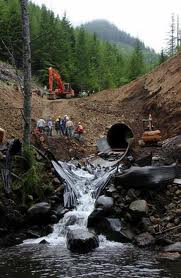
In a decision issued today, the Ninth Circuit ruled that logging road run-off that is channeled by a system of ditches and culverts into navigable waters is point-source pollution regulated under the National Pollution Discharge Elimination System, which requires permits to limit the amount of pollution discharged to meet water quality standards. Although the case involved logging roads on Oregon’s Tillamook State Forest, its reasoning applies equally to the national forest system because the Clean Water Act directs that federal agencies be treated just like all others when it comes to water pollution.

This decision builds upon an earlier ruling that subjected pesticide spraying from airplanes to NPDES permitting. The ruling invalidates EPA’s long-standing silvicultural exemption from point source permitting.

Several responses to this ruling are possible. Here are my guesses. Will the State of Oregon appeal to the U.S. Supreme Court? Yes. Will the Court accept cert? No. Will EPA and/or its delegated state regulatory agencies seek to issue programmatic, general permits for logging road-related sediment discharge, much like it does for certain classes of in-stream gold mining? Yes (the court invites EPA to do so). Will forest road owners face increased scrutiny from citizen Clean Water Act lawsuits? Duh! Will road engineers start designing outsloping roads without culverts and ditches? Perhaps so.

Other speculations welcome.

Aerial Fire Retardant Court Decision

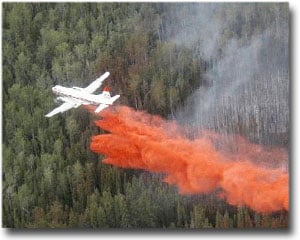
Yesterday (7/27), in a lawsuit brought by FSEEE, U.S. federal district court Judge Donald Molloy ruled that the Forest Service had violated the National Environmental Policy Act and the U.S. Fish and Wildlife Service and National Marine Fisheries Service had violated the Endangered Species Act in regard to the Forest Service’s use of aerial fire retardant. The retardant is used primarily in the West, with California accounting for half of the over 20 million gallons dropped from airplanes and helicopters annually. The retardant, which includes ammonia-based fertilizer, is toxic to fish and threatens rare plants.

The judge ordered the Forest Service to prepare an environmental impact statement and complete ESA consultation with FWS and NMFS by December 31, 2011. He also warned that failing to do could be met with sanctions, including contempt proceedings, which wouldn’t be the first time.

Read the 79-page court decision.