FS Chief Christiansen’s Job Appears Secure

Two former Obama officials, Robert Bonnie and his long-time associate Meryl Harrell, are the Forest Service-relevant Biden transition team members. They are also two of the three authors of a “transition memo” that frames their advice regarding USDA actions and policies through a climate lens.

Chief Christiansen may be heartened to read the memo’s caveat that “Notably, the Forest Service has no political positions; the Secretary should maintain that tradition . . .” Unsurprisingly, it appears her tenure as Chief will be secure after January 20, if she survives the Trump purge.

What other takeaways do ambitious readers glean from the memo?

Oregon Public Broadcasting “Timber Wars” Podcast

OPB has released most of its 7-part “Timber Wars” podcast.

The writer/director, Aaron Scott, spent a year on this impressive project, funded, in part, by an NPR grant. As in Bill Dietrich’s “The Final Forest,” the best book on this era, Scott sympathetically lets protagonists from all sides tell the story in their own words. [As one of those protagonists, Episode 3 — The owl, I’ll let my words on that subject speak for themselves.]

With the benefit of 30-year hindsight, however, Scott’s storyline sweeps more broadly than Dietrich could in 1992. Who could have anticipated that the Timber Wars would catalyze anarchist protests at the Seattle WTO? Or be the fuse that ignited science-denying, anti-government, class-based populism?

Scott’s production captures well the social paroxysms of those times and the indelible wounds they have left in a generation of northwesterners.

Worst Place to Work in the Federal Government?

The Forest Service isn’t quite the worst place to work in the federal government, but it’s steadily moving in that direction. According to the latest “Best Places to Work in the Federal Government” employee survey, the Forest Service’s ranking has dropped in every category; from leadership to pay to work/life balance, the Forest Service is in the bottom quartile.

Out of 420 federal agencies, the Forest Service 380th place is its lowest ranking ever. Remarkably, but perhaps not coincidentally, the U.S. Department of Agriculture counts four of the Bottom 10 agencies, including the National Institute of Food and Agriculture and Economic Research Service, which USDA leadership pissed off by moving their offices to another state.

The gap between the Forest Service and other land management agencies has grown. The BLM, which ranks #311, while still no bed of roses is at least only middling bad in half of the criteria measured. As is the National Park Service, which ranks about the same as BLM. Fish and Wildlife Service continues to rank in the top half of agencies.

Meanwhile, NASA remains the cat’s meow for federal employees.

Court Enjoins Logging Using “Condition-Based Analysis”

A federal district court judge has preliminary enjoined the Tongass’ largest timber sale because the Forest Service relied on “condition-based analysis” in its EIS. In addition to stopping logging, the court’s decision puts a wrench in the Forest Service’s proposal to add condition-based analysis to its NEPA rules.

Condition-based analysis treats acres as fungible; location doesn’t matter. From the Forest Service and timber industry’s perspective, a board foot may be a board foot, but for wildlife, recreation, scenery, and most everything else, location does matter: “the Project EIS does not identify individual harvest units; by only identifying broad areas within which harvest may occur, it does not fully explain to the public how or where actual timber activities will affect localized habitats.”

The decision stops logging until the court issues its final merits ruling, which is promised by March 31, 2020.

Fire Footprint

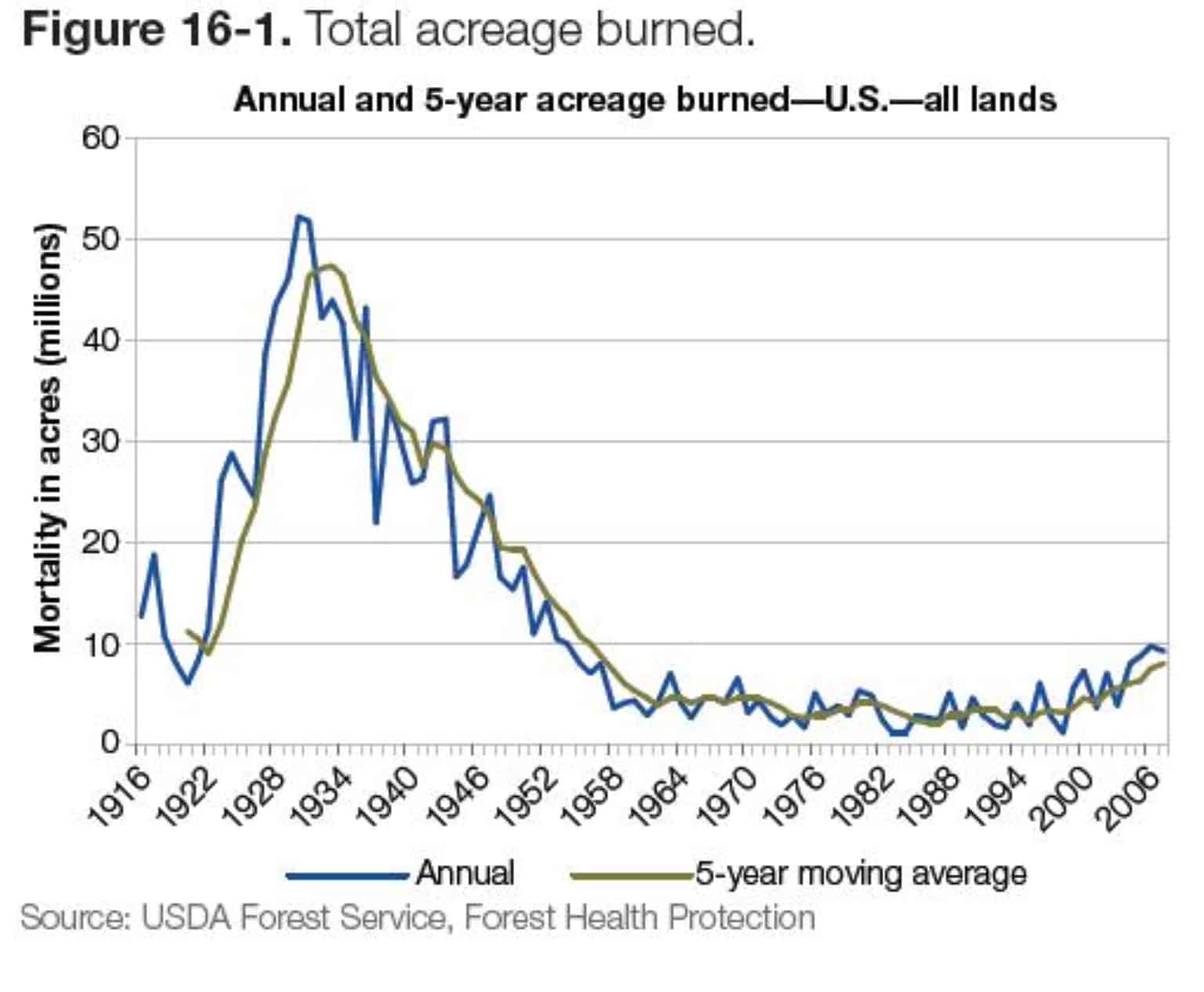
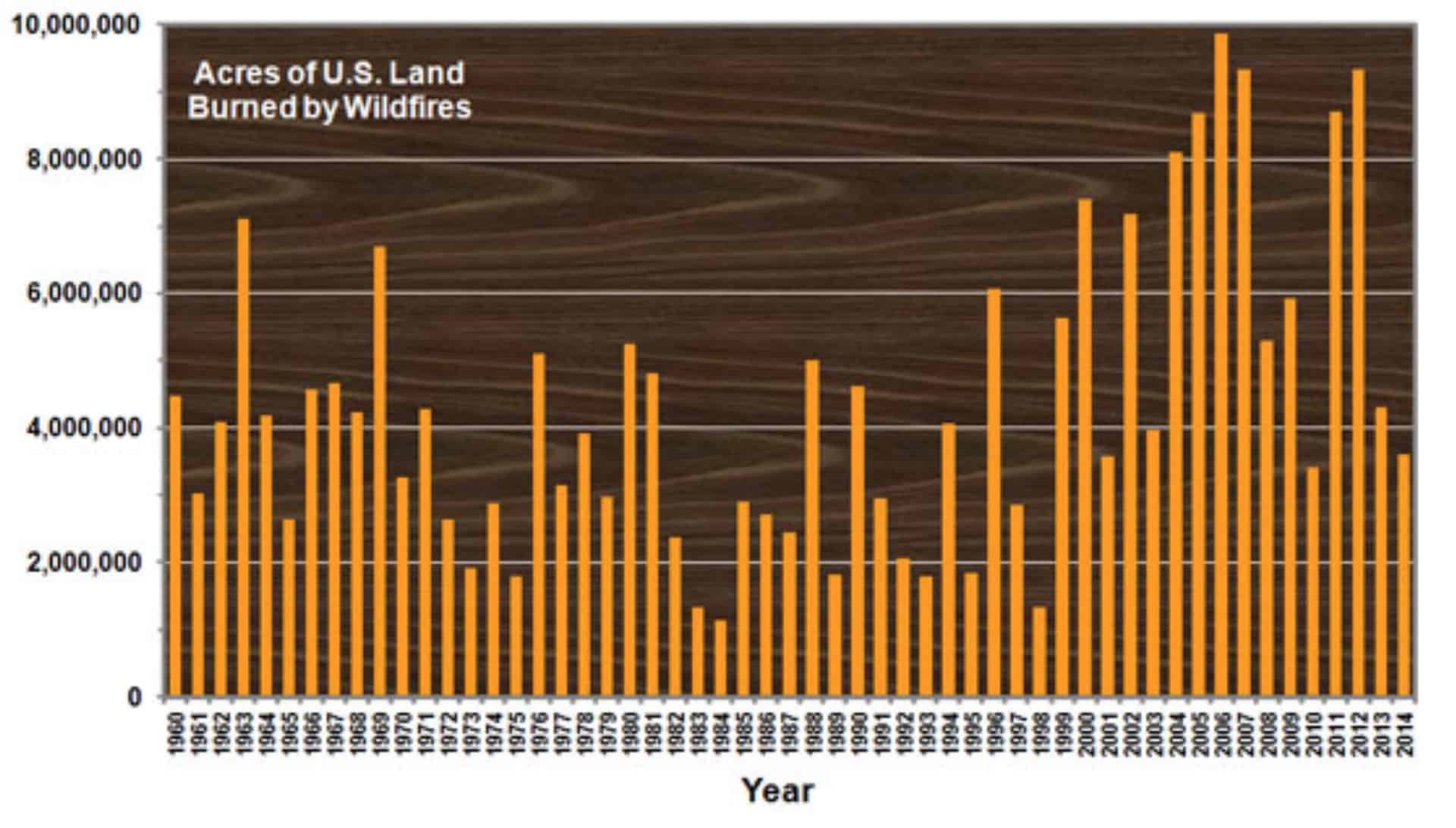
We’ve all heard about the dramatic increase in U.S. wildfire acres burned:

Oops! Wrong graph. Here’s the correct one:

Many attribute this trend to increases in atmospheric greenhouse gases. Another factor is how we manage wildland fire, as discussed by two firefighters. Travis Dotson is an analyst at the Wildlands Fire Lessons Learned Center, while Mike Lewelling is Fire Management Officer at Rocky Mountain National Park.

TRAVIS: Overall, what would you say are the biggest positive changes you’ve seen in our culture during your entire career?

MIKE: I think we are more mindful about how we manage fires now. I saw a map side-by-side of all the fires from the early 80s into the 90s and it’s all these little pinpricks of fires. And then you go into the 2000s to now and the footprints are a lot bigger. There’s a lot that goes into that. But I think part of that is not always throwing everything at every fire. Mother Nature uses fire to clean house and it doesn’t matter what we do, she’s going to do it eventually. So whether we put ourselves in the way of that or let it happen is an important decision. I think that, overall, risk management—how we respond to fires—is a significant advance.

TRAVIS: For sure. I’ve seen research showing that the best investment we can make is big fire footprints. That is what ends up being both a money saver and exposure saver down the line as well as an ecological investment, obviously. For so long, large fire footprints were only being pushed from an ecological perspective and now we’re talking about the risk benefits of changing our default setting away from just crush it. There is often an immediate and future benefit on the risk front (less exposure now AND a larger footprint reducing future threat).

XPRIZE

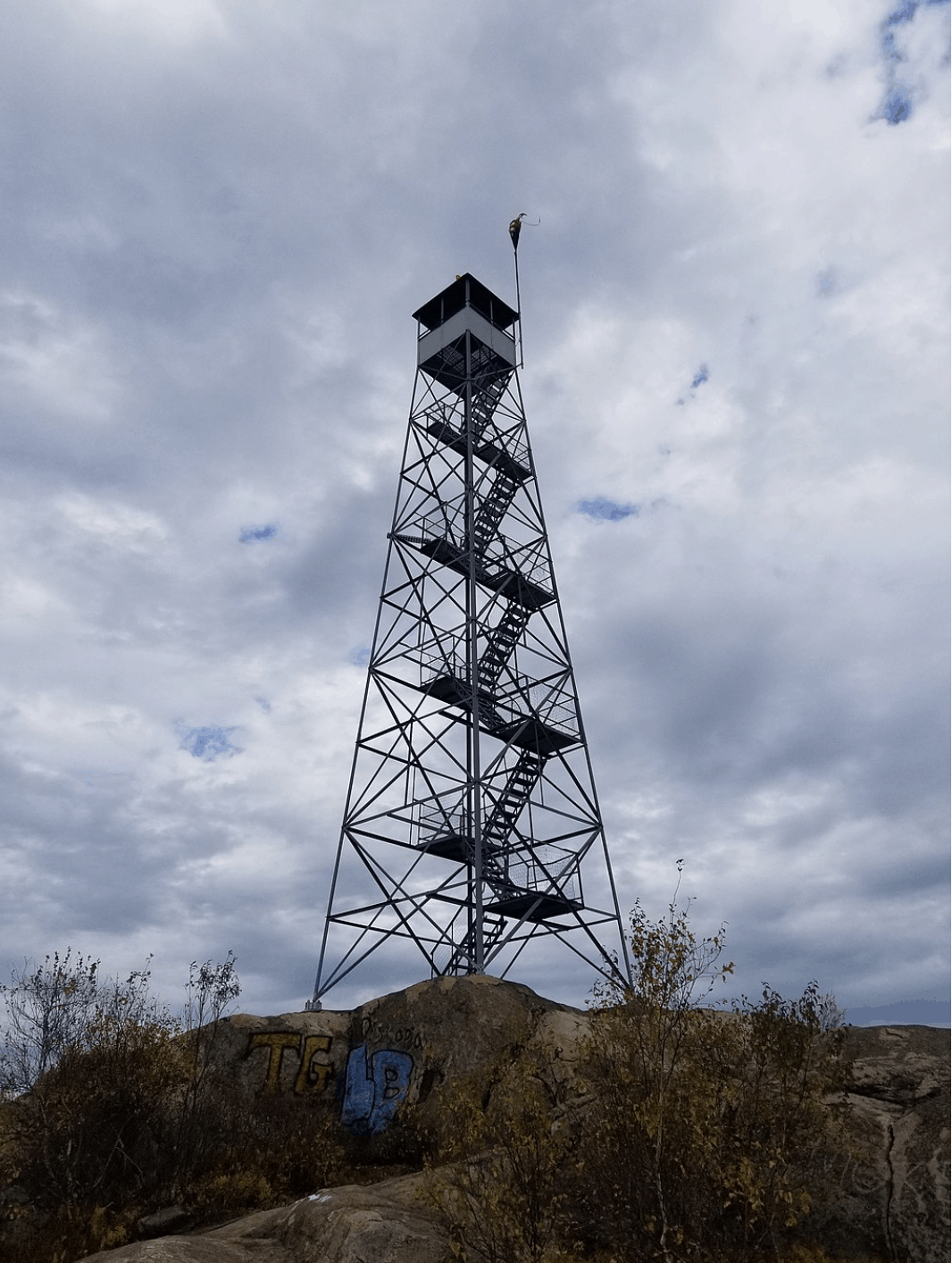
“XPRIZE, the global leader in designing and operating incentive competitions to solve humanity’s grand challenges, has announced a collaboration with California Governor Gavin Newsom, to design an XPRIZE competition that would drive innovation and develop hardware able to rapidly detect and extinguish wildfires.”

My entry:

Should a Few Big Old Trees Continue to Stand?

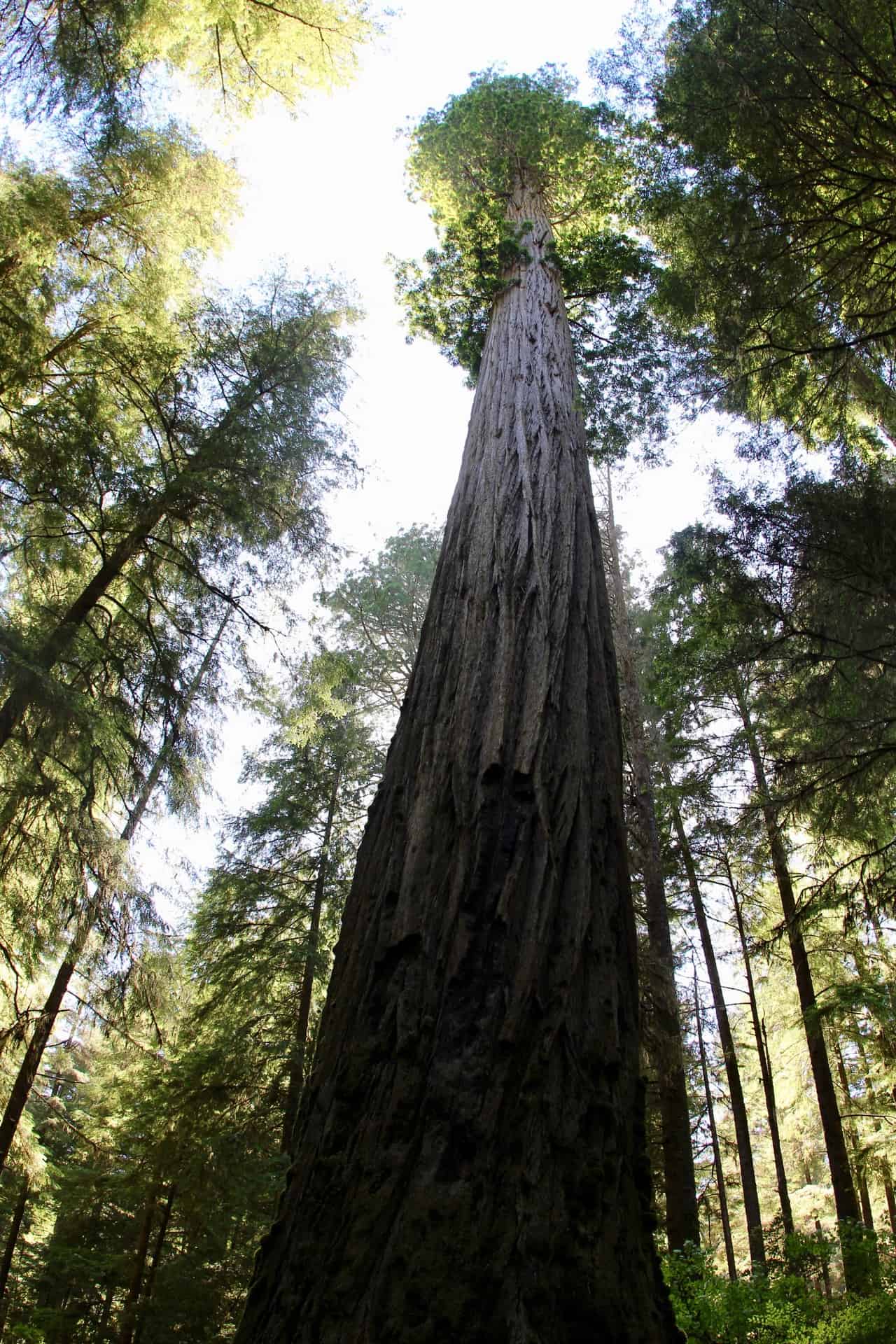
Last week, federal district judge William Alsup told California’s transportation department (CalTrans) that it had given short-shrift to the fate of several old-growth redwood trees that have the misfortune of living beside a coastal highway. CalTrans wants to widen Highway 101 as it passes through a redwood state park, thus allowing passage by extra-long trucks that currently must take long detours on their way to serve Humboldt County businesses.

The trees at issue “are thousands of years old, and can measure 300 feet tall with a diameter sixteen feet wide.” They are, as a practical matter, irreplaceable. Judge Alsup gets that and, if the final decision were his to make, he would choose trees over convenience for bigger trucks. But, as he is the first to admit, it is not his decision to make. With only NEPA processes on which to hang his judicial robe, Alsup makes the most of them!

And why not? Alsup comes from a long tradition of lawyers and judges who believe that environmental protection laws are intended to protect the environment. As a young lawyer, he clerked for Supreme Court Justice William O. Douglas during the 1971-1972 term in which Douglas wrote his famous dissent in Sierra Club v. Morton, which kicks off with a citation to “Should Trees Have Standing,” a law review treatise now enjoying a political renaissance.

[In his 1972 dissent, Douglas noted “the Forest Service — one of the federal agencies behind the scheme to despoil Mineral King — has been notorious for its alignment with lumber companies, although its mandate from Congress directs it to consider the various aspects of multiple use in its supervision of the national forests.” Prescient and accurate, as future events proved.]

In Justice Douglas, Alsup had a good mentor who would be proud of his protege’s sound instinct for putting the public interest ahead of a CalTrans bureaucracy beholden to the trucking lobby.

Trump Designates Largest Wilderness Area in Oregon’s Coast Range

Today President Trump signed the John D. Dingell, Jr. Conservation, Management, and
Recreation Act, which, among many other things, designates the Devil’s Staircase Wilderness. At over 30,000 acres, Devil’s Staircase now becomes the largest wilderness in Oregon’s Coast Range.

In the heart of timber country on the southern end of the Siuslaw national forest, the Smith and Umpqua Rivers define its boundaries. In the 1960s, the Forest Service imposed a moratorium on logging between these rivers pending completion of a soil erosion study. Although the study was inconclusive, the logging moratorium was lifted in 1980.

In 1984, when the Forest Service’s tried to resume logging, a federal district judge ruled the agency had violated the National Environmental Policy Act. The so-called “Mapleton” (named after the affected ranger district) injunction, stopping 700 million board feet of logging, was then the largest in U.S. history, surpassed only by the spotted owl lawsuit.

Speaking of spotted owls, Devil’s Staircase is home to the Coast Range’s highest numbers of these rare birds and the site of one of the decades-long spotted owl demographic studies. These studies provided much of the scientific foundation for the Northwest Forest Plan.

Of Grizzly Bears and Camels

Today, in Alliance for Wild Rockies v. Savage, the 9th Circuit ruled the Forest Service violated Kootenai national forest plan standards that regulate road densities to protect grizzly bears.

A Venn diagram would help explain the court’s reasoning, but since I don’t know how to draw one on-line, here’s a silly analogy.

Imagine a two-humped camel that has spent her long life carrying straws. Now old, weak and feeble, the vet advises, “No more straws should be put on your camel or she will collapse and die.” Chastened, the owner counts the straws — 1,000.

To simplify future straw management, the owner decides that from now on he will add and remove straws only from the camel’s small front hump, which carries 20 straws; the other 980 straws being on the large hump.

The owner dutifully keeps a running tally of the straws he adds and removes from the front hump. But, unbeknownst to him, his wife has been surreptitiously adding straws to the camel’s rear. In fact, some of the original 1,000 straws were probably hers, but no one knows for sure because the old straw records are missing.

The next day, the owner puts 6 new straws on his camel and, in an abundance of caution, removes 8, figuring that having only 18 straws on the small hump will provide a safety margin for his aging camel.

A day later, the camel dies. The vet is called. “Why did my camel die?” the owner asks mournfully. “I was careful to never have more than 20 straws on the front hump.”

“There were 1,452 straws on this camel!” exclaims the vet. “I told you your camel could tolerate no more than 1,000.”

“It was a smelly camel, anyway” his wife mutters, as she sweeps up the straws.
What Part of “Fire!!!” Is An Emergency Didn’t I Understand?

Apparently all of it. In an unpublished (i.e., non-precedential) memorandum, the Ninth Circuit affirmed a lower court’s decision that forest fires are emergencies within the meaning of a Forest Service regulation that exempts actions taken in response from NEPA. Plaintiff’s argument that the adjacent National Park Service doesn’t agree and had prepared an EA assessing its future fire response actions was “immaterial.”

Perhaps, someday, the Forest Service will use NEPA to engage the public in planning its response actions to fire. In the meantime, quoting an earlier district court case, “[a]t least in the context of wildland fire suppression, NEPA review can not possibly be conducted at the site-specific level because of the emergency conditions in which the fire occurs, and to allow the agency to conduct site-specific NEPA review after the fire has already been extinguished is contrary to the purposes of NEPA.” California ex rel. Lockyer v. United States Forest Serv., 2005 U.S. Dist. LEXIS 14357, *35, 60 ERC (BNA) 2104.