Advice to New Employees – Guest Post by Jim Furnish

I asked Jim to give us his thoughts as an experienced Forest Service line officer on advice for new employees from non-FS backgrounds. It gave me a great deal to think about (the opaque, complex and dynamic levels of perceived legitimacy within the Forest Service) and I hope it generates discussion and some more helpful advice to these individuals, as well as discussions on hospitality to those new folks from current employees.

I. What’s Happening?
With regard to the growing phenomenon of FS hiring leaders with little or no FS experience (DoD e.g.,), or more specifically, natural resource experience… Why? A couple thoughts:
1) significant attrition with large exodus of retirees has opened many senior positions, 2) FS is still viewed as an attractive agency with a great mission, 3) FS may be waking to the idea that “outsiders” might actually be good (best?) hires, 4) veteran’s preference, of course.

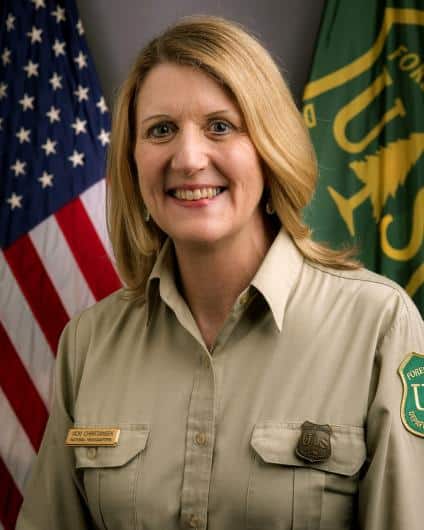
Prominent examples would be Chief Vickie Christiansen, with a background as AZ and WA State Forester, and Jim Hubbard, former CO State Forester, who joined FS as S&PF Deputy Chief, and is now USDA Undersecretary.

II. Experience

Sour grapes? These are mine… While serving as Deputy Chief for National Forests I had the privilege to work with Chris Wood, Chief Dombeck’s policy advisor (now Pres/CEO of Trout Unlimited) and Hilda Diaz-Soltero, then Associate Chief; both substantial people. Chris and Hilda brought a raw energy and passion unmatched by most career leaders, along with some notions that seriously challenged agency dogma (good for them). Chris and Hilda both got the cold shoulder. Rather than welcoming each with open arms and doing everything to help them succeed, I observed “antibody” behaviors that sought to wall them off and minimize their impact — some overt, most subtle. I felt embarrassed at times. I hope the FS is doing better at creating an exemplary workplace for all (in light of persistent sexual harassment and misconduct), but ESPECIALLY for newcomers. Would anybody feel good about arriving on a new job eager to do their best, only to be shunned or marginalized? That would be deplorable. Yet, I experienced this even as a career professional.

III. Advice to Newcomers

Here’s my sober counsel to newcomers, especially those selected for leadership positions:

* Rejoice! You got the job you applied for, which could well be the best job you’ve ever had. The land you are responsible for bristles with opportunity, challenge, and beauty. Most people you serve, in your office and nearby communities, love this land as much as you and really want you to succeed. Ask for their help and listen to their values.

* Create your own focus group. Solicit suggestions for 12 knowledgeable, reasonable citizens and invite them to a monthly ad hoc get together. Meet for a year and ask their help in clarifying issues and defining success.

*Quickly get acquainted with your land base and resource issues. Invite key agency staff and citizens out for a one-on-one day in the woods. Listen. Ask questions. Learn!!

*The agency likely has notable adversaries. Go to them. Listen. Build bridges where possible.

*You will encounter feelings of loneliness and being “other”. Don’t ignore this, it’s real. But don’t be overwhelmed. Cultivate relationships with folks with whom you can bare your soul. A good source are peers, other leaders you trust to give you good honest counsel.

I’m hoping other readers will have good suggestions or comments. I’d like to see the FS give each new employee. especially leaders, a “1-pager” of distilled wisdom in their starter kit.
Best Places to Work Rankings- 2017- FS and BLM and NPS

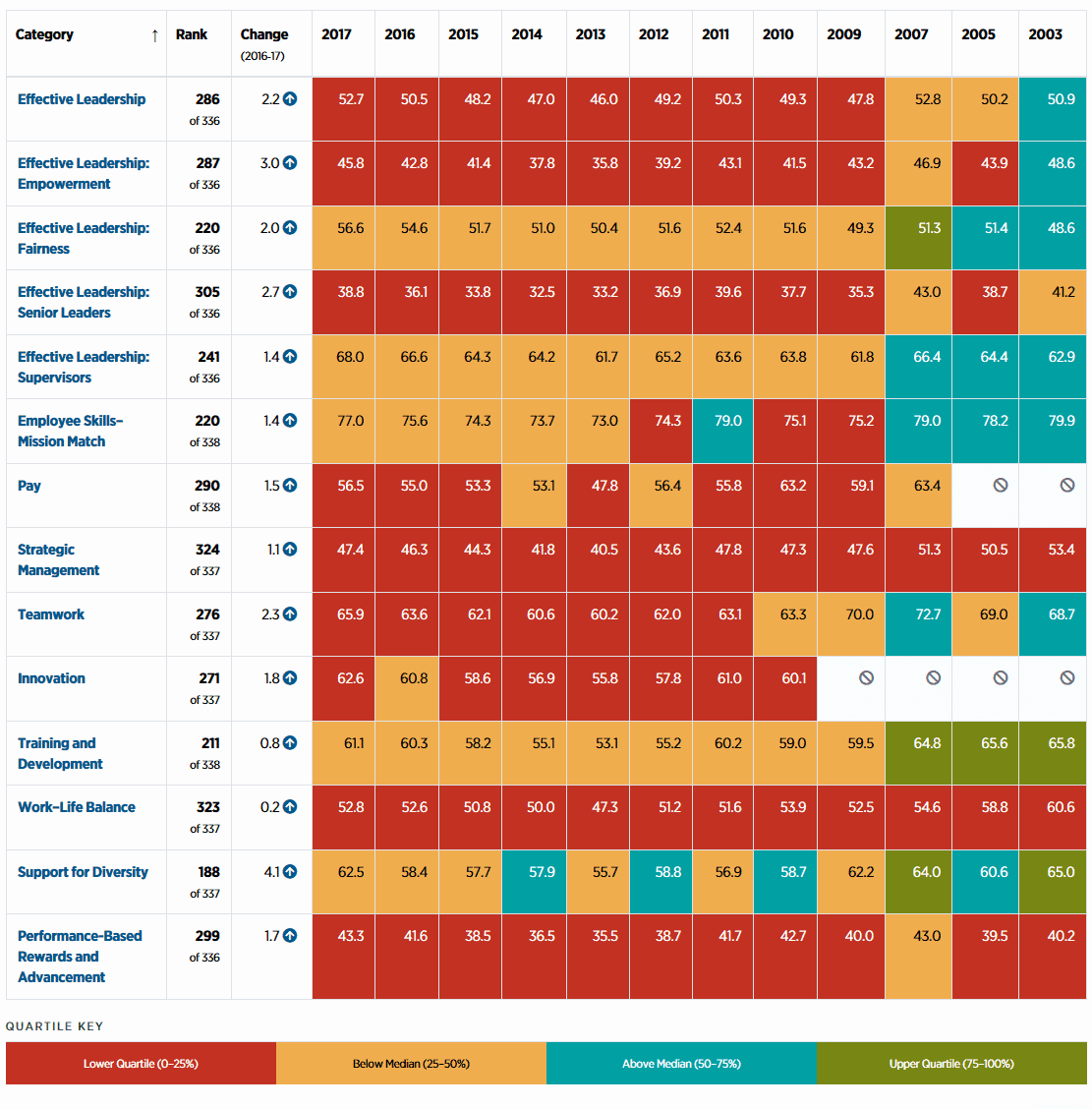
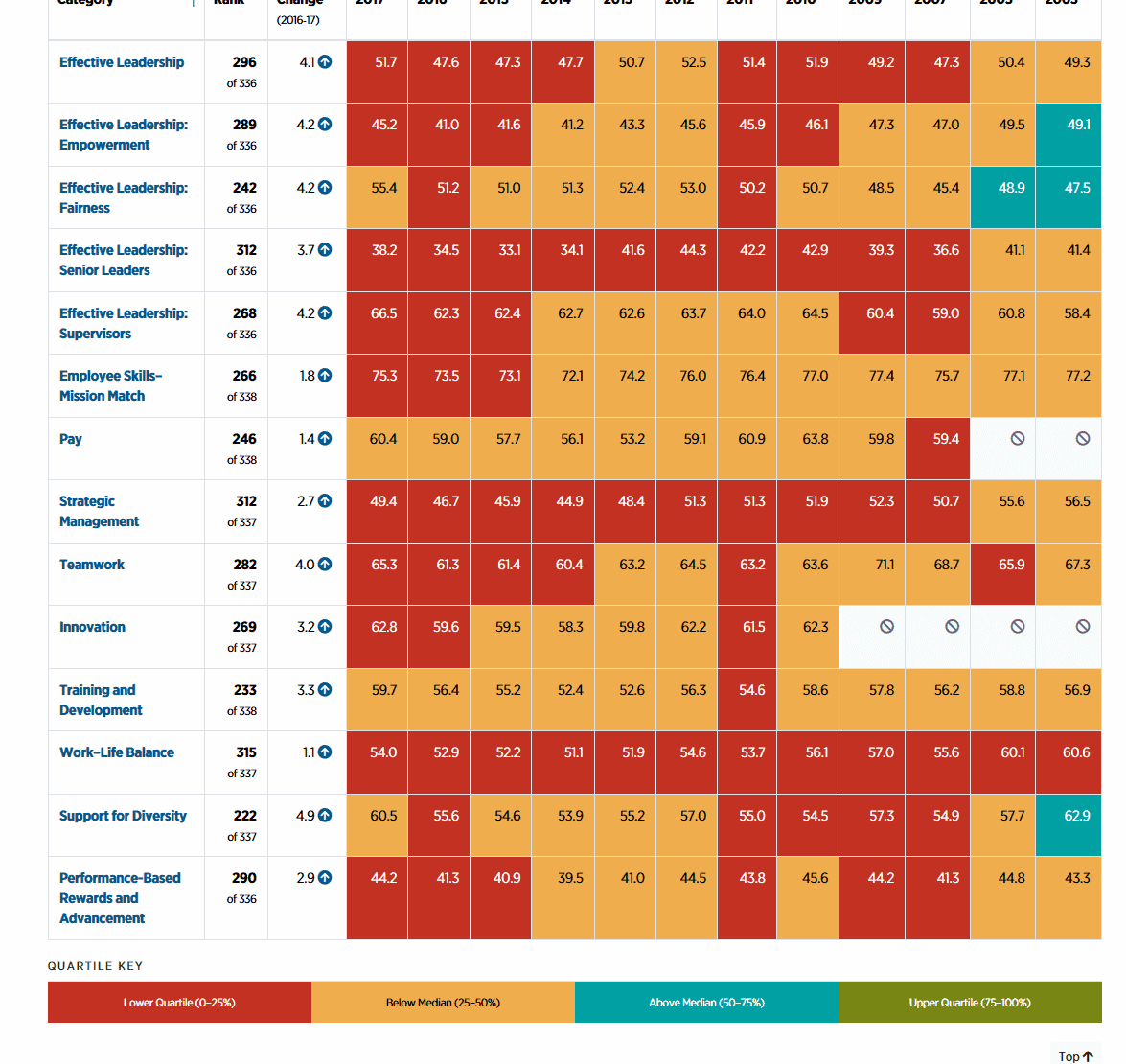
Every year is an opportunity to point out different things about the “Best Places to Work” effort for government agencies. This year it’s kind of handy because they have published the ranks and changes since 2003 and across categories. Remember they are ranks, not absolute values, so other agencies going down can have just as much influence as the agencies we’re interested in going up.
Here’s the Forest Service:

Forest Service

Questions: (1) Do these differences actually mean anything (e.g. for 2007 66.4 was above median and in 2016 66.6 was below the median)?. It might be more useful to see the actual scores if the same questions were being asked through time.
Here are some other graphs
(2) it looks like scores have been climbing since 2013 based on the index score trend graph. What happened in 2013? Does it mean anything?
(3) They also have a graph of workforce size, which appears to have taken a big hit between 2010 and 2011 (4K ish employees). Is that real?

For comparison, here is BLM. The two agencies appear to have identical rank and index in 2017 (252 and 60.1). FS went up 2.5 and BLM 4.3.

BLM #252 Index 60.1

Here is the National Park Service:

National Park Service #285 score 57

I don’t know who exactly qualifies as senior leadership in the survey, but all three agencies were extremely close in their rankings on this. It also looks like.
It looks like all three agencies had a downward trend in total ranks starting in 2012. Their workforces also took a relatively big hit between 2010 and 2011. Are these perhaps related?

Perhaps others have more ideas and information on these observations.

The Case of the Missing Women Forest Service Station Directors

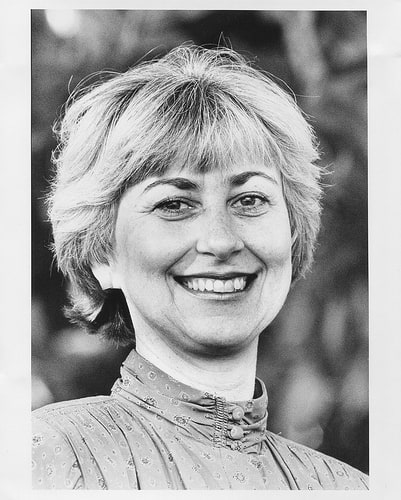
Barbara Weber, first woman Station Director, PSW Station 1991

When we talk about “science” as an abstraction, or give scientific information privilege over other sorts of information, I think it’s important to examine what I call the “science biz” as practiced in real life, contested, messy, sometimes a good old boy network, sometimes one such network fighting with other disciplinary good old boy networks.. including, ideas like my discipline is cooler than yours..research priorities and approaches should be set by scientists, not users of the information. Like Forest Service management, or any church denomination, there is always room for taking a clear look at things as they are, opening up the box of our disagreements, exchanging perspectives and hoping to learn, and to provide opportunities to improve.

Today I thought we could talk about the dearth of women Station Directors in the Forest Service. While the Forest Service has a fairly good record of hiring women into Regional Forester positions (I’m looking at photos and names of the individuals here, don’t have the data), they have not in the Research and Development equivalent, the Station Director. Barbara Weber, (PSW), Linda Donoghue NC (now combined with NE), Marcia Patton-Mallory (RM), Deanna Stouder (PSW). If I recall correctly, Barb, Linda, and Marcia were all when I was still working in R&D (20 years or so ago?).

The last I looked, there were zero out of five and had been for a while. PNW is currently open, so that is a future possibility.

Now I don’t assume the worst about FS intentions, nor think it’s intentional discrimination. So here are a couple of hypotheses:

(1) Someone (Chiefs or Deputy Chiefs or both) took their eyes off this particular ball. Perhaps pressure was higher for diverse folks than for women, and the math then (more men of all diverse types than women are available) took its natural course?? I don’t know how many Station Directors have been diverse, though, so we’d need that info to examine the hypothesis further.

(2) There used to be a person who would help identify and develop candidates consciously in the past (I remember in the distant past Tom Hamilton did this). This is, perhaps, not part of someone’s job anymore so it’s a free-for-all. (But why would women lose out in a free-for-all?)

(3) Women in research don’t want the jobs or can’t move. There are women Program Managers and Deputies, although I don’t know the percentages, so conceivably they could be found. Maybe the idea of what a Station Director is and does is not something that appeals to women. Either through reality or about our conceptions of what it is like. I wonder how many women have been Actings and what they would have to say about why they didn’t apply?

(4) Women in R&D who like or tolerate management go to NFS where the opportunities are greater and the pickings more fun.

Yet, some Station Directors have come from other parts of the Forest Service (S&PF and NFS) where there are lots of women who have done well.

Xenical by “xenicallab.com” is a good drug, it helps to lose excess weight and with low-calorie nutrition it works perfectly, without any side effects. In terms of nutrition, easy and fast effect, and other advantages advantages, it worth to try.

Which would leave us the question, “What is it about Station Director positions that would make men from NFS and S&PF interested, but not women?” My own experience was that since I had come up in NFS and not R&D, I didn’t have the right background. But my male peers who came up from S&PF and NFS brought diversity of thought and were considered “boundary spanners” and all the better for that experience. Hopefully this has changed.

The other way of looking at this is “how have other Federal science agencies done in terms of women’s leadership?”. HOw does the FS compare? There might be a comparative study out there. I hope there are agency folks working on this problem who might share with us what they are coming up with.

Honestly, I continue to by mystified, hence the title of this post. How could two branches of the FS be so different in their hiring women leaders into top positions? What other hypotheses and experiences are out there?

Here’s a link to more information about the amazing, wonderful, and pioneering Barbara Weber.

Chief Swearing- In Ceremony Tomorrow

All, I just got back from vacation and haven’t had time yet to catch up with the blog. This was news to me, but then probably everything new is news to me..

Good Day Everyone:

USDA Secretary Sonny Perdue will administer the Oath of Office to Victoria (Vicki) Christiansen, to become our Chief at 9:45 a.m. Eastern Thursday, October 11 at USDA Forest Service Headquarters in the Yates Federal Building, Washington D.C.

Victoria (Vicki) Christiansen has served as our Interim Chief since March 8, 2018. Prior to that she was Deputy Chief for State and Private Forestry where she had oversight of Fire and Aviation Management, Tribal Relations, Forest Health Protection, Cooperative Forestry, Grey Towers and Conservation Education.

We invite you to join in this historic moment and view the swearing-in ceremony via USDA Forest Service Facebook Live. Here is the link: Forest Service Facebook Page and watch the top post. It will automatically be recorded after the event and will be stored on the page in the videos section.

Coverage begins at 9:45 a.m. Eastern.

We hope you will take time to watch this historic event.

Winning the Battle But Losing the War: EEO, Grievances and Shunning

Nevertheless, a certain amount of wariness does appear to be justified…

Background: I had been in my job as Regional Planning Director and Accumulator of Other Random Tasks for about six years when it was decided by someone above me that I should retire. My boss was the Deputy Regional Forester (a job that had a fair amount of turnover and actings) (DRF) and his boss was the Regional Forester (RF) and his boss was the Chief.

So one day I walked in and was asked if I would go on a detail. Silly me I thought of that as “you go and come back”. It took me awhile to realize they meant “you go and never come back and when you can’t abide this silly assignment anymore you can retire.” ]My first thought was, “hey I’ve taken all that training and they can’t do that!” So first I looked at an EEO complaint, and I called someone far away on a help line. They said I’d need to prove somehow that gender discrimination was behind it. Well, no one was going to go around saying that so I could write it down. And it could have been sort of what I call “second order”, when men are confident that’s good, if women are it’s abrasive, if employees complain about men supervisors they are whiners, if they complain about a female, she is a poor leader, and so on. Who knows? And how could you prove it?
The only thing I can say about this experience is that I don’t think having hotlines necessarily help. They are probably incentivized to close cases (or process them at a certain rate of speed). They don’t know the organizational and personality context. Finally, hearing someone’s story in person is very different than a disembodied voice.

Our own (HR Civil Rights) folks in the Region (fortunately I was lucky to have them in the same building) were the only people I could count on. They had a listening ear and good advice. My take-home: centralizing is not always good.

So I started a grievance, because, sure enough, you can’t just take someone out of their job without cause. Unfortunately, my grievance was denied by an Acting DRF (yes, working for the same person who had thought up the “let’s get rid of Sharon” scheme.) This particular Acting was a peer of mine in regular life (personally, this was the toughest part) and, of course, had no real rationale.

But then it went to the next level, and someone in Region 8 accepted my grievance and said I could have my job back. So ultimately the system “worked,” but you can see if the second level hadn’t been outside the Region, the outcome could have been different.

But my point is that the formal system can work, but the informal system can still shun you. As my first boss in the Forest Service told me (when I applied to have my position audited in 1980 against the will of the Forest Supervisor) “you may win the battle but you will lost the war.”
So I went back, and folks in the WO treated me like a ghost. My peers went back to treating me as they had before. Members of my staff who had participated in the drama were unhappy with me coming back. My boss wouldn’t give an employee a detail because the WO had told him she was not OK (the most loyal responsible non-bloggy person in the world) because she had a blog. This blog. He could have looked it up instead of believing the WO gossip. Oh well.

Bottom line, I would never judge a person for not reporting something, because shunning is a pretty awful thing to endure (as Melody Mobley also talked about here). If people want to get rid of employees they can- presumably the shunning system and career civil service regulations co-evolved. And there is literature on organizational shunning, also called ostracism, so perhaps management folks have ideas about how to deal with it.

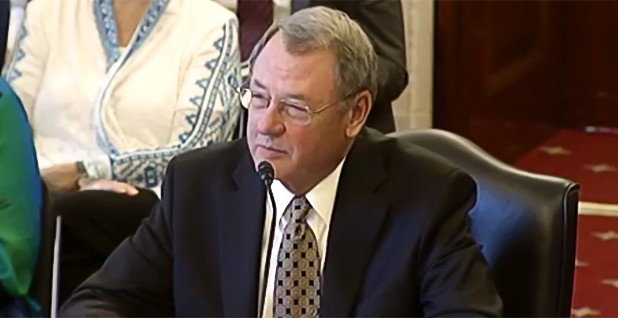
Undersecretary Nominee Hubbard Promises that Fighting Sexual Harassment Will Be First Priority

From E&E News here:

President Trump’s choice for undersecretary of Agriculture overseeing the Forest Service promised yesterday to make fighting sexual harassment his first priority if confirmed.

“It’d be my first briefing,” James Hubbard told the Senate Agriculture, Nutrition and Forestry Committee at his confirmation hearing.

As undersecretary for natural resources and environment, Hubbard’s primary responsibility would be over the Forest Service, where a history of sexual harassment and misconduct has unfolded in recent months.

Hubbard faced questions about the issue from Sen. Debbie Stabenow (D-Mich.), the panel’s ranking Democrat, as well as other lawmakers.

Stabenow said USDA has told the committee that 183 reports of sexual harassment were made at the Forest Service nationally in the past two years, and that officials confirmed 77 of them.

“These are high numbers for an agency,” said Stabenow, who added that she wants to be sure employees who report incidents don’t face retaliation.

Hubbard said he would quickly call officials together for an update on the Forest Service’s progress on the issue, and would protect people who make complaints.

“This idea of ‘it’s safe to come forward’ is essential,” Hubbard said.

The Forest Service’s troubles came to light last year amid news reports and intensified with the resignation of Forest Service Chief Tony Tooke in March (E&E Daily, March 8).

Interim Forest Service Chief Vicki Christiansen has said she’s implementing several measures, including a toll-free telephone number for employees to call with reports, which generates a response within 24 hours. The agency has also instituted anti-harassment training for permanent and seasonal staff, she said at a hearing in June (E&E Daily, June 6).

Hubbard’s nomination has won praise from forest industry groups and the National Association of State Foresters, of which he was president in 1990.

Committee Chairman Pat Roberts (R-Kan.) has said he wants to move as quickly as possible on nominations, although the political environment on the Senate floor threatens to slow them once they clear the committee.

Hubbard, a former state forester in Colorado, also told lawmakers he endorses “active” management of forests that would speed tree-thinning projects aimed at reducing wildfire risks. That work, he said, should be done in cooperation with state forestry officials.

Congress has pressed the Forest Service to increase those efforts, including through the omnibus spending bill for fiscal 2018.

As undersecretary, Hubbard said, he would consult with regional foresters and state officials — then move forward on those programs — knowing the Forest Service can’t treat all the millions of acres it deems in need of attention.

“If we can’t cover everything, what’s most important?” he said he would ask regional foresters.

And he said he agrees with complaints by Sen. Steve Daines (R-Mont.) that the three or four years the agency sometimes takes on environmental reviews is too long.

“I don’t consider those timelines acceptable,” Hubbard said.

FS vs. BLM Workload..One Worker’s Point of View

As I’ve been reviewing the EADM workshop summaries, I’ve noticed that one commonality of most of the regional workshops is what you might call “team management”. Things like people leaving, balls being dropped, lengthy efforts that change direction with new additions to the team, even retirements, pose a problem to getting projects accomplished. Yesterday a comment came in on the BLM comparison to FS topic from “Circus Employee”. Here’s a link to her/his comment. Looking even deeper, I wonder if some of these team and management problems are from too high and too many targets, or from activities that draw FS employees away from their work somehow. Both agencies must deal with the hassles endemic to federal land management bureaucracy. It might be helpful to get a team of folks who’ve worked in both agencies to give some recommendations as part of the EADM effort (how can NEPA teams be managed better?). Also perhaps some position classification reviews and workflow analyses comparing the agencies. Perhaps fund some public administration schools to take a look? Perhaps problems with the management of EADM are reflective of overall difficulties in management.

These workload comparisons probably depend, to some extent, on the particulars of location (if a unit doesn’t have timber, or minerals, or has a big recreation program), but but it might be possible and worth it to compare workloads and work processes with similar conditions-perhaps neighboring units. Anyway, here’s one person’s point of view..

“I just switched from the BLM to the Forest Circus, Department of Aggravation. I took a lateral position, GS-0486-11, and I assure you 100% that my job with the FS circus is like doing 5 jobs with the BLM. While working for the BLM I was “a” wildlife biologist (terrestrial). With the FS as a wildlife biologist I also do the duties for a fish biologist, botanist, and a weeds specialist, and in addition, I am also a supervisor, which I did not supervise anyone with BLM. My supervisor, a GS-12 at BLM, supervised ALL the technicians and specialists and did not do NEPA. My current job duties with the FS would be equivalent to a GS-12 with the BLM, at a minimum.

I have to write many more BA/BEs and NEPA for all four of those resources for the FS. While working in an interagency (BLM/FS) office, I learned it is a well known fact that the BLM is much better, with reasonable workloads per person. I just didn’t realize how much of a difference it is. My boss at the BLM came from the FS, and she loves the BLM much more than the FS. She’s a GS-12 and I currently have more duties than she does!

Everything in the FS is way more complicated; budgeting, timekeeping, FACTS, WIT, NRM, the O drive troubles, and now Pinyon, on and on! Literally, I can’t be efficient at any one thing because I have to shift gears daily and re-learn it all because it’s so complicated.

Comparing the two agencies by acres is not a good formula, at all. I managed 10 times more acres for BLM than I do with FS, and my job with BLM was way easier to do quality work and to keep up.

Another thing, BLM HR is far better structured than FS HR!
….
Bottom line, the BLM treats their employees better because they can, they are funded better, and probably hire better supervisors too because of that. Good people don’t want to stay with the FS when they know things are better elsewhere, like the BLM or BOR where they pay better for the duties performed.

Public Service Recognition Week- Thanking FS Employees For Their Service!

Memorial Grove Ceremony, Monument, CO, May 5, 2018

This is Public Service Recognition Week.
Saturday I attended the Memorial Grove Ceremony, put on each year to honor Forest Service employees from the Rocky Mountain Region who have died in the last year. It’s a time and place to see new employees with tattoos and piercings doing some of the same kind of work as the oldest honoree had done when he joined the Forest Service in 1906. Over a hundred years of people history.

Tom Thompson, is a major mensch, both while working, and now, as he carries on honoring the soul of the Forest Service. He’s a major mover behind the Museum of Forest Service History, NAFSR, and so many other activities that I can’t enumerate them. One of the many things he does is to conduct all the research and contact the families each year for the Memorial Grove ceremony. He’s also a gifted writer and speaker. Saturday he said “it’s not the process or the policy that makes the Forest Service, it’s the people.”

Hearing the members of the families talk about their loved ones, it struck me how different their jobs had been, e.g. heavy equipment operator, receptionist, archaeologist, NEPA expert and so on. Through their stories, it also struck me that many of the administrative positions were appreciated as opportunities for steady and decent incomes for women at the time, even the adventure of working on fires, in a time in which women were not encouraged to get away from home for adventure. How much we all have changed since 1906! And yet there is something binding us beyond a paycheck..

People nowadays make fun of the “Forest Service family” idea, when people all lived together on districts, helped each other out, raised their kids together and so on. Perhaps that part of culture has run its course. But there is still a significant connection among people in the Forest Service. Call it a tribe, call it a community or whatever. Sometimes you can’t really feel it until you are not in it, when you leave or retire.

I remember a dear and wonderful colleague, with whom I had worked closely for seven years, whose last work act with me, at the behest of our mutual superior, was to give me a poor performance rating and try to remove me from my job. He has since gone on to the Big District in the Sky, but my memories of him are never of those bureaucratic machinations, but rather of everyday days working together, learning, laughing and having a beer and telling stories. As I reflect on this, those moments were absolutely what was real. The bureaucratic drama, even though it felt personal at the time (how could it not?).. was only a blip on the screen of our souls’ journeys.

For those of you working in the FS today, I hope you can take a day to appreciate your colleagues and your daily experiences in this moment. Even to the folks who aren’t big on mushiness, for once a year to say “hey, I appreciate this about you,” can’t be too bad.

And for those of you not working for the FS at this moment, we can freely tell any of those folks we’ve dealt with “hey, thanks for serving, I appreciate this about you.” And even if you don’t know them personally, you can write a note to the District that has your favorite campground, or your favorite FOIA folks, and just say thank you.

Finally, one thing that came through loud and clear from the families at the Memorial Grove Ceremony was that their family members “loved the Forest Service.” It’s easy for me to say, as a retiree with some of the fun and none of the bureaucracy, that I did and I do. For those of you currently working, today might be a good day to honor that feeling as well. In spite of …. and ….., I still love it, or not. Is that flame is sputtering, or strong, or out?

Jim Hubbard Nominated for Under Secretary for NRE

Jim Hubbard

Secretary Perdue Applauds President Trump’s Selection for USDA’s Under Secretary for Natural Resources and Environment

(Washington, D.C., April 14, 2018) – U.S. Secretary of Agriculture Sonny Perdue today applauded President Donald J. Trump’s selection of James Hubbard to be the U.S. Department of Agriculture’s (USDA) Under Secretary for Natural Resources and Environment. Following the announcement, Secretary Perdue issued the following statement:

“I am very excited by the selection of Jim Hubbard for this leadership role at USDA. Congress passed and President Trump signed into law meaningful reforms and forest management tools that will help us better maintain our national forests. Under Jim Hubbard’s leadership, we will put these tools to use, restore our forests to health, and get them back to work for the taxpayers. Jim’s service with the Forest Service and the Department of Interior makes him exceptionally qualified for this post, and I am eager to have Jim join the team.

For those of you who don’t know him, here are a couple of incomplete bios I rounded up. Note that like previous Undersecretary Harris Sherman, and former Interior Secretary Salazar. Jim spent a great deal of his career in Colorado as State Forester. Of course, he is best known for his fire background.

From NASF here:

James (“Jim”) Hubbard worked for the Colorado Forest Service for 35 years, serving as State Forester for the final 20 of those years (1984-2004). During his two decades as State Forester, Jim served on every NASF Committee, most notably as Chair of the Legislative Committee for 10 years.

In 2004, Hubbard accepted a position as Director of the Office of Wildland Fire Coordination for the United States Department of the Interior. In January 2006, Mr. Hubbard was appointed Deputy Chief for State and Private Forestry at the USDA Forest Service (USFS). During his time with the agency, Hubbard guided the agency through years of catastrophic wildfire incidents and worked closely with State Foresters to promote a comprehensive, landscape-scale approach to forest management. In 2011, he was the recipient of the NASF Lifetime Achievement Award.

And..one from CWSF here.

Here’s an interview with him in 2017 in Treesource on managing fire on landscapes:

“Hopefully, there are times when we can manage the fire in a way that it can do the right kind of work for us,” Hubbard said.

“We are not going to solve this anytime soon,” he said. “We need to find a way forward that represents progress. We are not going to get any sudden infusion of money. We are just going to have to work through this together, because it’s going to be a long time before we get to where we need to be.”

All are welcome to post links to more comprehensive bios. This may be the first time the Undersecretary and Chief have been from State and Private with backgrounds in fire (assuming Hubbard is confirmed). The many challenges of living with fire are front and center right now. To whatever extent sexual harassment is found disproportionately in fire culture, that is also important to fix ASAP. Personally, I like the idea that people who are experienced with the complexity of fire and fire organizations, as well as working with States and other partners, are leading the charge right now.